KANSAS DEATH ROW
THE NINE WHO WAIT
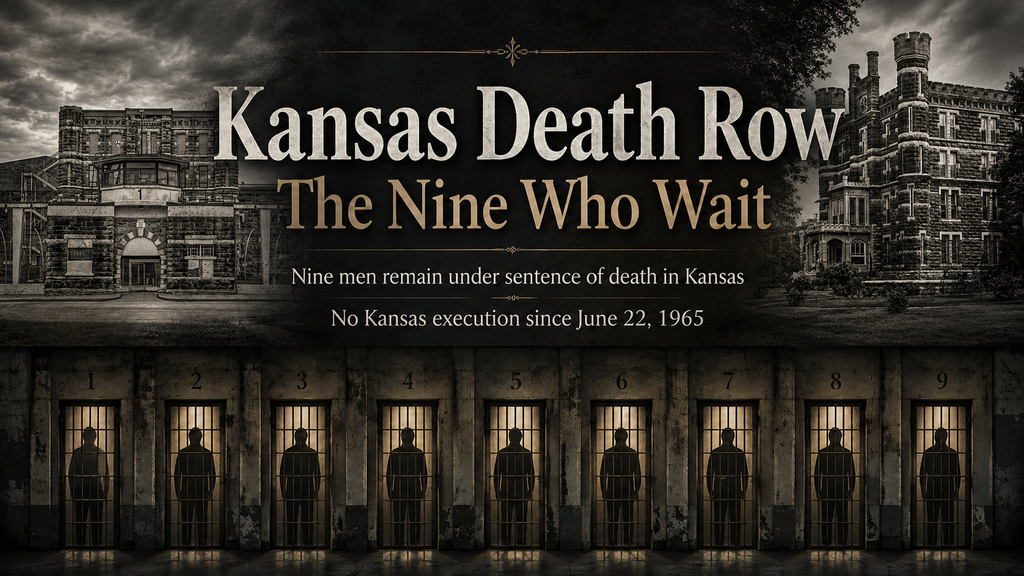
Nine Men. Nine Death Sentences. No Kansas Execution Since 1965.
Kansas carried out its last executions on June 22, 1965, when George Ronald York and James Douglas Latham were hanged at the Kansas State Penitentiary in Lansing.
Nearly three decades later, Kansas reinstated the death penalty, effective July 1, 1994. Today, nine men remain under sentence of death in Kansas.
Kansas does not maintain a separate prison officially designated as “Death Row.” Prisoners sentenced to death have generally been housed in maximum-security or administrative segregation within the Kansas Department of Corrections.
The dates below show the date each man’s original death sentence was imposed. Because several sentences were overturned and later reinstated during lengthy appeals, the years shown should be understood as the time elapsed since the original death sentence—not necessarily uninterrupted time under an active death sentence.
GARY WAYNE KLEYPAS
Convicted: Capital Murder
Victim: Carrie Williams, age 20
County: Crawford County
Original Death Sentence: March 11, 1998
Time Since Original Death Sentence: More than 28 years
Gary Wayne Kleypas was convicted of the 1996 murder of Carrie Williams, a 20-year-old Pittsburg State University student. Williams was attacked inside her Pittsburg apartment.
Kleypas had previously been convicted of murder in Missouri and had been released on parole before Williams was killed.
In 1998, Kleypas became the first person sentenced to death under Kansas’s restored death-penalty law. His original death sentence was later overturned because of errors in the sentencing proceeding. A second jury again sentenced him to death in 2008.
Of the nine men currently under Kansas death sentences, Kleypas has been associated with a death sentence the longest.
28 YEARS
Since his original death sentence
JONATHAN DANIEL CARR
Convicted: Capital Murder and related crimes
Victims: Jason Befort, Brad Heyka, Heather Muller and Aaron Sander
County: Sedgwick County
Original Death Sentence: November 15, 2002
Time Since Original Death Sentence: Nearly 24 years
Jonathan Carr and his brother, Reginald Carr, were convicted following a violent December 2000 crime spree that became known as the Wichita Massacre.
Five young adults were held captive during a home invasion, robbed and sexually assaulted before being taken to a snow-covered soccer field and shot. Jason Befort, Brad Heyka, Heather Muller and Aaron Sander were killed. One victim survived and became a critical witness against the brothers.
The Carr brothers were also convicted in connection with other crimes committed during the same period.
Jonathan Carr received a death sentence in November 2002. His case has since traveled repeatedly through the Kansas and United States Supreme Courts.
23+ YEARS
Since his original death sentence
REGINALD DEXTER CARR JR.
Convicted: Capital Murder and related crimes
Victims: Jason Befort, Brad Heyka, Heather Muller and Aaron Sander
County: Sedgwick County
Original Death Sentence: November 15, 2002
Time Since Original Death Sentence: Nearly 24 years
Reginald Carr was convicted alongside his brother Jonathan for the crimes that became known as the Wichita Massacre.
In December 2000, the brothers entered a Wichita home occupied by five young adults. The victims were held captive, robbed and sexually assaulted. They were later taken to a soccer field and shot.
Four died. One survived.
The brothers were additionally prosecuted for crimes committed during a series of robberies and attacks in Wichita, including the shooting of Ann Walenta, a Wichita Symphony Orchestra cellist who later died from her injuries.
Reginald Carr was sentenced to death on the same day as his brother: November 15, 2002.
23+ YEARS
Since his original death sentence
JOHN EDWARD ROBINSON SR.
Convicted: Capital Murder
Kansas Capital-Murder Victims: Izabela Lewicka and Suzette Trouten
County: Johnson County
Death Sentence: January 21, 2003
Time Under Sentence: More than 23 years
John Edward Robinson Sr. became one of the most notorious murder defendants prosecuted in Kansas.
In 2000, investigators searching property Robinson owned in rural Linn County discovered the bodies of young women concealed inside barrels. The investigation ultimately connected Robinson to multiple murders spanning Kansas and Missouri.
In Kansas, Robinson was convicted of the murders of Izabela Lewicka, Suzette Trouten and Lisa Stasi. Because Stasi disappeared years before Kansas reinstated the death penalty, that conviction did not carry a death sentence.
Robinson was sentenced to death following his convictions for capital murder. He later accepted responsibility in Missouri cases involving additional victims and received life sentences there.
23+ YEARS
Since his Kansas death sentence
SIDNEY JOHN GLEASON
Convicted: Capital Murder
Victims: Mikiala “Miki” Martinez and Darren Wornkey
County: Barton County
Original Death Sentence: August 28, 2006
Time Since Original Death Sentence: 20 years
Sidney John Gleason was convicted in connection with the February 2004 murders of Mikiala “Miki” Martinez, 19, and Darren Wornkey, 24, near Great Bend.
Prosecutors argued that Martinez was killed because Gleason feared she might provide police with information concerning an earlier robbery.
Wornkey was shot and killed, and Martinez was later taken to a rural location and murdered.
A Barton County jury convicted Gleason of capital murder and recommended death. His sentence became part of years of litigation concerning Kansas’s capital-sentencing procedures, including proceedings that reached the United States Supreme Court.
His death sentence ultimately remained in effect.
20 YEARS
Since his original death sentence
SCOTT DEVER CHEEVER
Convicted: Capital Murder of a Law-Enforcement Officer
Victim: Greenwood County Sheriff Matthew Samuels
County: Greenwood County
Death Sentence: January 23, 2008
Time Since Original Death Sentence: More than 18 years
On January 19, 2005, Greenwood County Sheriff Matthew Samuels went to a rural residence near Virgil, Kansas, while investigating a suspected methamphetamine operation.
Inside the residence was Scott Cheever.
Cheever shot and killed Sheriff Samuels during the operation and was later convicted of capital murder and other charges involving law-enforcement officers at the scene.
He was sentenced to death in January 2008.
Cheever’s conviction produced a major constitutional case concerning the use of psychiatric evidence and eventually reached the United States Supreme Court. His death sentence was ultimately upheld.
Cheever also has a unique connection to Lansing: unlike most of Kansas’s death-sentenced prisoners historically housed at El Dorado, Cheever has been housed at Lansing Correctional Facility.
18+ YEARS
Since his original death sentence
JUSTIN EUGENE THURBER
Convicted: Capital Murder
Victim: Jodi Sanderholm, age 19
County: Cowley County
Death Sentence: March 2, 2009
Time Since Original Death Sentence: More than 17 years
On January 5, 2007, Jodi Sanderholm, a 19-year-old Cowley College student and member of the college dance team, disappeared from Arkansas City.
Her abandoned vehicle was later recovered from a lake. Investigators subsequently found Sanderholm’s body in a rural area.
Justin Eugene Thurber was arrested and charged with her abduction, sexual assault and murder.
A Cowley County jury convicted Thurber of capital murder and recommended the death penalty. He was sentenced in 2009.
His case has remained the subject of extensive appeals, including litigation concerning whether intellectual disability would constitutionally prohibit his execution.
17+ YEARS
Since his original death sentence
JAMES KRAIG KAHLER
Convicted: Capital Murder
Victims: Karen Kahler, Emily Kahler, Lauren Kahler and Dorothy Wight
County: Osage County
Death Sentence: October 11, 2011
Time Since Original Death Sentence: Nearly 15 years
On Thanksgiving weekend in November 2009, James Kraig Kahler went to the Burlingame home of Dorothy Wight, the grandmother of his estranged wife.
Four members of the family were shot and killed: Karen Kahler; the couple’s daughters, Emily, 18, and Lauren, 16; and Dorothy Wight, 89.
Kahler and Karen’s young son was also at the residence but survived.
Kahler was convicted of capital murder and sentenced to death in 2011.
His appeal eventually reached the United States Supreme Court, where Kahler challenged Kansas law concerning the insanity defense. In 2020, the Supreme Court rejected his constitutional challenge, leaving his conviction and death sentence in place.
14+ YEARS
Since his death sentence
KYLE TREVOR FLACK
Convicted: Capital Murder and Murder
Victims: Kaylie Bailey, Lana Bailey, Andrew Stout and Steven White
County: Franklin County
Death Sentence: May 18, 2016
Time Since Original Death Sentence: More than 10 years
In the spring of 2013, four people disappeared from a rural property near Ottawa, Kansas.
Investigators ultimately discovered the bodies of Andrew Stout, Steven White and 21-year-old Kaylie Bailey at the property.
Still missing was Kaylie’s 18-month-old daughter, Lana.
A search ended several days later when the child’s body was found concealed inside a suitcase recovered from a creek.
Kyle Trevor Flack was arrested and ultimately convicted of capital murder in the deaths of Kaylie and Lana Bailey as well as murder charges involving Stout and White.
A jury sentenced Flack to death on May 18, 2016. He is the most recently sentenced of Kansas’s current nine death-sentenced prisoners.
10+ YEARS
Since his death sentence
DEATH PENALTY IN KANSAS
Kansas’s modern death-penalty law took effect on July 1, 1994.
Yet the story of capital punishment in Kansas reaches much farther back—and directly through the walls of the Kansas State Penitentiary.
From 1944 through 1965, fifteen men were executed by hanging at KSP.
Among the last were Richard Eugene Hickock and Perry Edward Smith, executed on April 14, 1965, for the murders of the Clutter family near Holcomb—a case later made internationally famous by Truman Capote’s In Cold Blood.
Only two months later, on June 22, 1965, George Ronald York and James Douglas Latham were executed.
They were the last men put to death by the State of Kansas.
Kansas abolished capital punishment in 1972 following changes in federal constitutional law. After several unsuccessful attempts to restore it, the Legislature enacted a new death-penalty statute in 1994.
Since that law took effect, Kansas juries have again imposed death sentences.
But Kansas has not carried out an execution in more than sixty years.
Today, nine men remain under sentence of death.
THE NINE WHO WAIT
Their cases span nearly three decades.
The longest has been associated with a Kansas death sentence since 1998.
The newest received his sentence in 2016.
And still, the last execution carried out by the State of Kansas occurred here in Lansing—
June 22, 1965.